The right Checkly alternative depends on what you actually use Checkly for. If you run Playwright browser tests as code, look at Better Stack, Datadog or Grafana. If you mostly need endpoint uptime, quiet alerts and a status page, a focused uptime tool like Uptime Beacon fits better and costs less. Below, we compare seven options on browser checks, API checks, alerting, status pages, price and data location.
TL;DR
- Checkly is strongest at monitoring as code with Playwright browser checks. If that is your daily workflow, stay close to it or pick Better Stack or Datadog.
- If you mainly watch HTTP endpoints, TCP ports, cron jobs and certificates, you don’t need a synthetic testing platform. A lighter uptime tool is cheaper and simpler.
- Uptime Beacon opens an incident only after several failures in a row, confirmed from a second location on paid plans, so on-call engineers aren’t paged for a network blip.
- Every Uptime Beacon plan, Free included, comes with an MCP server for AI assistants, and all results are stored in the EU.
- Before you switch, inventory your checks, alert routes and status page, and run both tools side by side for a while.
Table of Contents
- What Checkly does well, and why people look elsewhere
- Two different jobs: synthetic testing or uptime monitoring
- Checkly alternatives compared
- What the pricing looks like
- Perspective
- How to choose by team type
- EU data residency: what to verify
- Switching from Checkly: effort and risks
- Try Uptime Beacon for the uptime half of Checkly
- FAQ
- Sources
What Checkly does well, and why people look elsewhere
Checkly is built around monitoring as code. You write checks in your repository, run them through your git workflow, and use native Playwright for full browser tests. Ranktora’s 2026 review lists a free plan with 10 uptime monitors, a fastest interval of 30 seconds on Team and one second on Enterprise, and native Playwright checks with full test suites.
People search for alternatives for a handful of recurring reasons:
- Usage-based billing. Checkly bills by check runs. PulseSignal’s comparison notes that a Team plan includes 12,000 browser and 100,000 API runs, with prepaid add-ons for more capacity and overages billed per run. That is fair for heavy testers, but harder to forecast than a flat monthly price.
- Scope. If you don’t write browser tests, you pay for a testing platform you never open.
- Alerting and on-call. Teams that want schedules and escalations in the same product look at tools that bundle them.
- Data location. European teams increasingly ask where results, logs and credentials are stored.
None of these is a flaw in Checkly. They are signs that your needs may have shifted. The first step is to decide which of two jobs you need done.
Two different jobs: synthetic testing or uptime monitoring
Browser checks script a user journey: log in, add to cart, pay. API checks assert on a response body, headers and latency. Uptime monitoring asks a simpler question, repeatedly and from several places: is this endpoint, port or host reachable and healthy right now?
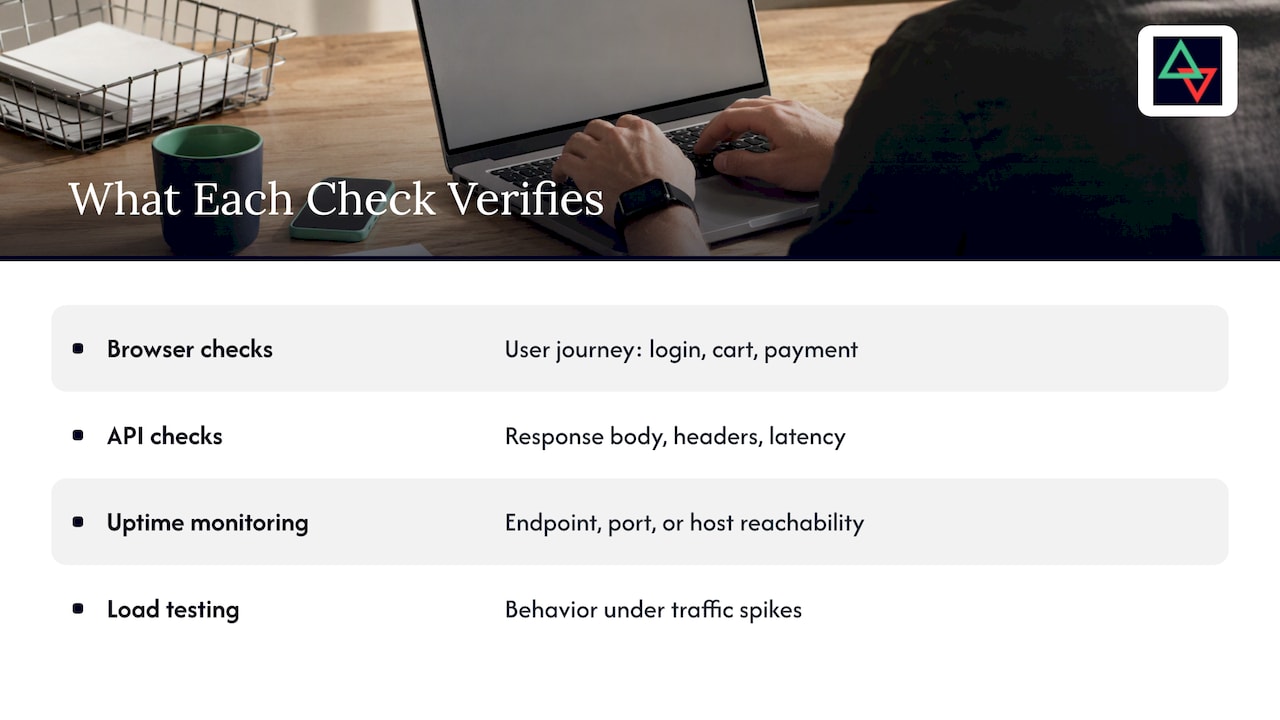
There is also a boundary worth knowing. APIScout notes that synthetic monitoring is not load testing: these tools verify correctness and basic latency under normal conditions, not behavior under traffic spikes. If load testing is on your list, budget for a separate tool or a platform that includes it.
If your Checkly account is mostly HTTP checks with a few assertions, the second job is the one you have. Our guides on API uptime monitoring and how synthetic monitoring tools differ go deeper on where the line sits.
Checkly alternatives compared
The table summarizes what each option is best at. Pricing and plan limits change often, so confirm current numbers on each vendor’s own pricing page before you decide.
| Tool | Best for | Browser checks | API / uptime checks | Alerting and on-call | Status pages |
|---|---|---|---|---|---|
| Uptime Beacon | Quiet, reliable uptime for small teams | No | HTTP, TCP, hosts, heartbeats, certificate and domain expiry | Email, Slack, webhook | Yes, independent of the dashboard |
| Better Stack | One product with on-call included | Hosted Playwright transaction checks | Yes, with heartbeats | Schedules, escalations, phone and SMS | Yes |
| Datadog Synthetics | Teams already on Datadog | Yes | Yes, priced per test run | Through the wider Datadog platform | Via Datadog |
| Grafana Cloud Synthetic Monitoring | Teams on Grafana and k6 | Scripted checks via k6 | Yes | Through Grafana alerting | Via Grafana |
| OneUptime | Open-source, self-hostable platform | Yes | Yes | On-call included | Yes |
| Hyperping | Playwright plus uptime in one plan | Yes | Yes | On-call included | Yes |
| openstatus | Uptime with built-in status pages | Lighter focus | Yes | Yes | Yes |
Uptime Beacon
Uptime Beacon checks HTTP endpoints, TCP ports and hosts from five regions: EU Central, EU North, US East, US West and Asia Pacific. An incident opens only after several failures in a row, confirmed from a second location on paid plans. That design exists for one reason: nobody should be woken by a blip on one network path.
It also covers heartbeat monitoring for cron jobs, certificate and domain expiry watches, public status pages that don’t depend on the dashboard, and maintenance windows on Starter and above. It does not run browser journeys, so it replaces the API and uptime part of a Checkly setup, not Playwright suites.
Plans, as published: Free at €0 per month (5 monitors every 5 minutes from EU Central, one alert channel, one status page, no card), Starter at €14.99 per month, Pro at €39.99 per month and Business at €89.99 per month. Extra capacity is an add-on: 10 more monitors on Starter for €5 per month, 50 more on Pro for €10, 100 more on Business for €15, and 10 more certificate or domain expiry watches for €5. Enterprise has no published price.

Better Stack
Better Stack bundles uptime monitoring, hosted Playwright checks, incident management, on-call rotations and status pages. Ranktora’s review reports a free plan with 10 monitors and 10 heartbeats, paid plans starting at £21 per responder per month on annual billing, and a 30-second fastest interval on paid plans. Responder-based pricing means cost grows with the size of your on-call rota. It is a good pick if you want schedules, escalations and phone alerts in the same product as the checks.
Datadog Synthetic Monitoring
If Datadog already holds your metrics and traces, adding synthetics keeps everything in one place. APIScout reports that Datadog charges $15 per 10,000 API test runs, priced separately from APM and infrastructure monitoring. For a team that only needs endpoint checks, that is a big platform to adopt. For a team already inside it, it is the path of least resistance.
Grafana Cloud Synthetic Monitoring
Grafana’s synthetic monitoring is built on k6, which suits teams that already write k6 scripts and use Grafana dashboards. It fits an engineering culture that likes scripting everything, similar in spirit to Checkly’s code-first approach.
OneUptime
OneUptime positions itself as an open-source Checkly alternative with monitoring, status pages and on-call in one platform. The open-source angle matters if you want to self-host or inspect the code. The trade-off with any self-hosted platform is that you now run the monitoring system, which has to stay up when your own infrastructure doesn’t.
Hyperping
Hyperping pitches Playwright browser checks combined with uptime monitoring, on-call and status pages in a single plan. It is the closest match if you want to keep browser checks and consolidate separate modules into one bill.
openstatus
openstatus is built for uptime monitoring with built-in status pages, and is also open source. It suits teams that want a lean tool and publish status often.
What the pricing looks like
Checkly’s published numbers vary depending on the plan family and billing period you look at. PulseSignal’s 2026 comparison states Checkly starts at $9 per month, with free Hobby plans across its product areas, Starter at $24 per month and Team at $64 per month. APIScout reports a $24 per month entry point with 25,000 API check runs, 3,000 browser check runs and 22 global locations.
The lesson is not which figure is right. It is that usage-based plans need a calculation before you commit:
- Count your checks.
- Multiply by runs per day at the interval you need.
- Add browser runs separately, since they are metered separately.
- Compare the monthly total to a flat-rate plan.
A worked example: 40 endpoints checked every minute is 57,600 runs per day, or about 1.7 million a month. On a usage-based plan, that volume is where overages appear. On a flat plan with a monitor limit, the cost is the plan price plus any add-on.
Perspective
Most teams that leave a synthetic testing platform don’t leave because it is bad. They leave because they were paying to maintain a test suite when the real need was simpler: know quickly when production is really down, and don’t get woken when it isn’t.
That is why we built Uptime Beacon around fewer false alarms first. An incident opens only after repeated failures, and on paid plans a second region has to confirm it. In our experience as engineers who ran production in banking, fintech, telecom and SaaS, the pager is only useful if people trust it.
The second thing we care about is how engineers work now. The MCP server is on every plan, Free included. You connect Claude, ChatGPT, Cursor, VS Code, Codex or any MCP client to https://app.uptimebeacon.eu/mcp, sign in, and ask why a monitor is failing, region by region. With “Allow changes” turned on for a team, the assistant can also create, pause and resume monitors, acknowledge incidents and start maintenance windows. Nothing can be deleted over MCP.
Last, every result is stored on a control plane and database in the EU, which makes the compliance conversation shorter.
Aaditya Parashar
How to choose by team type
Solo developer or indie hacker. You want a free plan that doesn’t ask for a card and an alert that reaches you. Look at the free tiers: Checkly and Better Stack list 10 monitors in Ranktora’s review, and Uptime Beacon’s Free plan gives you 5 monitors every 5 minutes, one alert channel, one status page and the MCP server.
Small SaaS team. You need API monitoring, a status page, cron heartbeats and certificate expiry watches without a tool to maintain. See how this looks in our API and cron monitoring for SaaS teams page, and read our guide to paging only for real failures.
Agency or freelancer. Many small sites, many status pages, predictable cost. Flat plans with add-ons are easier to quote to a client than per-run billing.
Larger DevOps or SRE team. If you already use Datadog or Grafana, staying in that ecosystem avoids another vendor. APIScout frames the choice the same way: Datadog Synthetics for Datadog teams, Better Stack when on-call scheduling should be included, Checkly for monitoring as code.
Teams that need Playwright. Keep a browser-check tool for the critical journeys, and consider running a separate uptime tool for the broad layer of endpoints. The two jobs don’t have to live in one product.
EU data residency: what to verify
If you serve European customers or have GDPR obligations, location matters, but “GDPR compliant” does not mean “stored in the EU”. One 2026 guide advises checking the specific data center location, the sub-processor list, where AI prompts are processed, and whether a data processing agreement is available before you sign.
Apply that list to any tool on this page, ours included. Uptime Beacon stores every result on a control plane and database in the EU, and is operated by Wealth Beacon OÜ in Estonia. For the wider set of questions, read our piece on EU data residency beyond location.
Switching from Checkly: effort and risks
Migration is mostly bookkeeping, and the risk is gaps in coverage during the move. A safe sequence:
- List every check and tag it: plain uptime, API assertion, or browser journey.
- Map alert routes. Note which checks page whom, through which channel, at what hours.
- Export your status page content, including subscribers and custom domains, so the new page is ready before you cut over.
- Recreate the uptime and API checks first. Those are the easiest to move and carry the most pager risk.
- Run both tools in parallel for a week or two, and compare incidents. Disagreements show you where thresholds differ.
- Move browser checks last, or keep them where they are.
- Retire the old checks only once an incident has been handled end to end in the new tool.
The biggest risk is quietly losing a check that nobody remembered. The inventory step guards against it. For setting thresholds in the new tool, our uptime monitoring guide and API monitoring best practices cover what to check and how to alert. If you are coming from another tool, our Pingdom alternatives comparison follows a similar path.
Try Uptime Beacon for the uptime half of Checkly
If most of your Checkly checks are HTTP endpoints, ports and cron jobs, start on the Free plan: 5 monitors every 5 minutes from EU Central, one alert channel (email or Slack) and one status page, no card. Connect your AI assistant to the MCP server and ask it to walk through a failing monitor region by region.
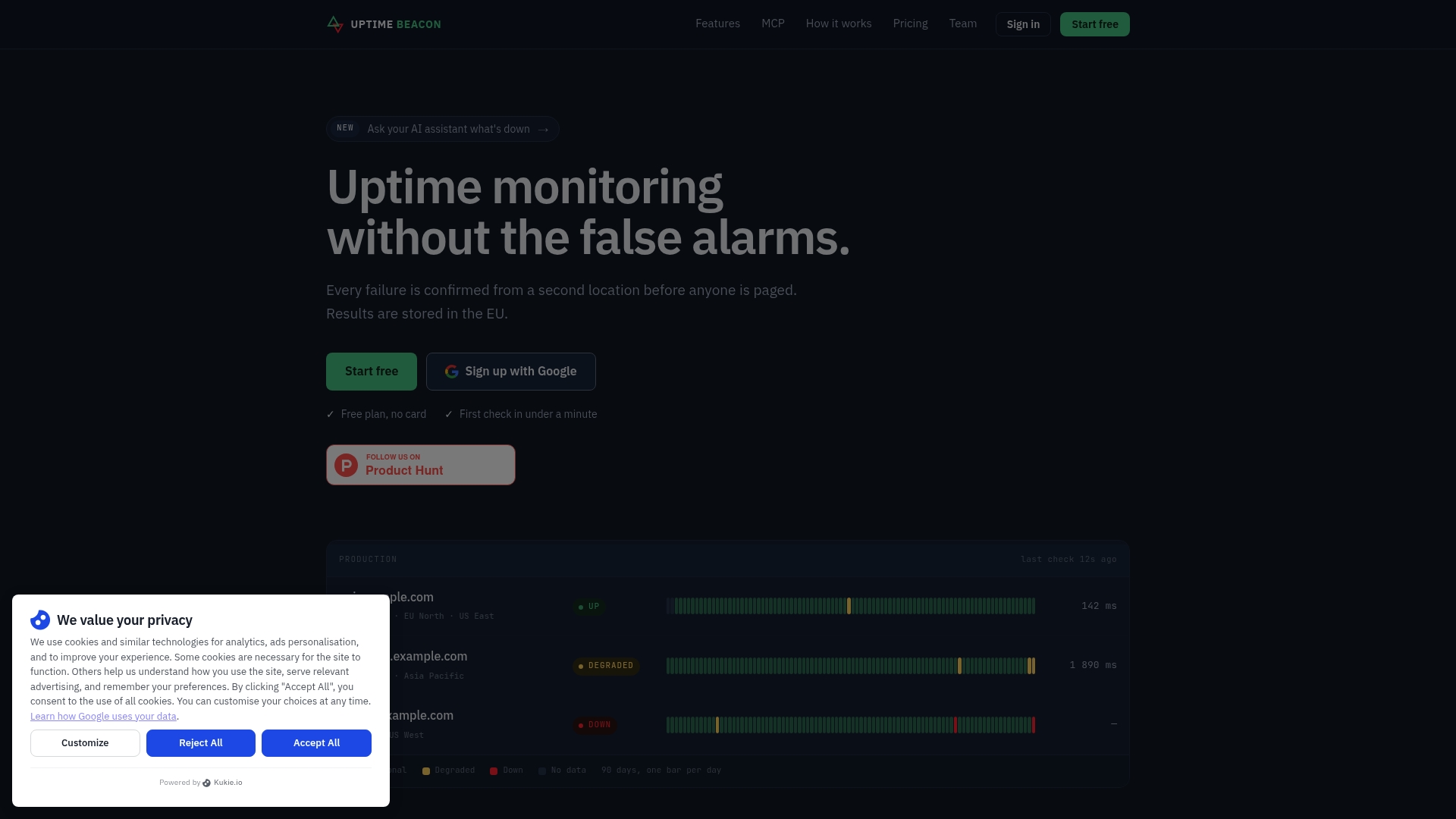
When you need more monitors, faster checks or second-location confirmation, Starter is €14.99 per month, Pro €39.99 and Business €89.99. See the plans on Uptime Beacon and set up your first monitor in a few minutes.
FAQ
What is the best free Checkly alternative?
It depends on what you need. Better Stack and Checkly both list 10 monitors on their free plans, according to Ranktora. Uptime Beacon’s Free plan includes 5 monitors, a status page and the MCP server with no card, and OneUptime and openstatus are open-source options.
Can I replace Checkly’s Playwright checks with an uptime monitor?
Not directly. Browser journeys need a tool that runs Playwright, such as Better Stack, Hyperping or Datadog. An uptime monitor covers endpoint reachability and API health, which for many teams is most of their checks. Some teams run both layers.
Is usage-based pricing cheaper than a flat plan?
Only at low volume. Per-run billing rises with check frequency and the number of endpoints, so run the numbers for your own check count first. Flat plans with a monitor limit are easier to forecast, especially for agencies quoting clients.
Does EU data residency matter for monitoring data?
It can. Monitoring results include URLs, response metadata and sometimes headers, so teams with GDPR obligations often want to know where they are stored. Ask each vendor for the data center location, sub-processors and a DPA, as the checklist above suggests.
Sources
- Checkly Review 2026: Website Monitoring Features & Pricing, Ranktora
- Checkly vs Embrace: Pricing Comparison (2026), PulseSignal
- Best API Monitoring Tools 2026, APIScout
- EU Data Residency Support Tools: 7 Compared (2026), Helpable


