If you are looking for a Cachet alternative, you most likely want a status page that stays current, does not need a server of yours to babysit, and does not fall over during the very incident it is meant to explain. Our pick for engineers and small teams is Uptime Beacon: monitoring and a public status page in one product, with a free plan, an incident that opens only after confirmed failures, and a status page that does not depend on the dashboard. The other seven options below fit specific cases, and we say which.
TL;DR
- Cachet is a self-hosted status page only. It does not watch your services, so you still need separate monitoring and someone to run the PHP stack.
- Uptime Beacon pairs monitoring with a status page, opens incidents only after repeated failures confirmed from a second location (paid plans), and its Free plan includes one status page and 5 monitors, no card.
- Choose Uptime Kuma if you want to self-host everything. Choose a hosted status-page tool if all you need is subscriber messaging.
- If you must keep data in the EU, check where every result is stored before you compare features.
Table of Contents
- Why teams leave Cachet
- What to check before you pick
- The options at a glance
- 1. Uptime Beacon: monitoring and status page together
- 2. Uptime Kuma: the self-hosting route done properly
- 3. openstatus and Kener: open source with monitoring built in
- 4. Instatus: a hosted page with a free tier
- 5. Atlassian Statuspage: the familiar name
- 6. Status.io: metrics and subscriber-heavy pages
- 7. Hund: components and multi-region checks
- Making the choice
- Let your AI assistant read the incident
- EU data residency
- Start with the Free plan
- Our view: a status page is the last step, not the first
- FAQ
- Sources
Why teams leave Cachet
Cachet is an open-source status page system. It lets you post incidents and component states to a page your customers can read. That is useful, and it is also all it does.
Three things push people away from it:
- Maintenance pace. FAUN.dev’s alternatives ranking scores Cachet 58/100, tenth of the ten tools it rates. A profile on Unsubbed from March 2026 puts its last stable release in 2023, with the core team rebuilding version 3.0.
- Hosting work. The software costs nothing, but the same profile estimates a $6 to $12 monthly VPS plus the time for the PHP and Laravel stack, database, cron, SSL, backups and patching. The math only works if someone on your team will own that deployment.
- No monitoring. A status page that someone must update by hand is only as fast as the person who notices the outage. Teams end up gluing Cachet to a separate checker.
That last point decides the whole comparison. Your real question is not “which status page,” it is “how does my page learn that something broke, and who gets woken up for it.”
What to check before you pick
Five criteria separate the options in practice:
- Does it detect the outage itself? Pages fed by hand lag behind reality.
- Does the page survive the incident? A status page hosted on the same stack that is down helps nobody.
- How noisy are the alerts? One failed check from one location is often a network blip, not an outage.
- Who runs it? Self-hosting trades subscription fees for your own on-call hours.
- Where is the data stored? Matters for GDPR-bound teams.
It also helps to know how good incident updates read. Subrupt’s SRE guidance says to lead with customer impact rather than internals, to post updates on a fixed cadence of 15 or 30 minutes, and to close with a resolution and a postmortem link. Any tool below can carry that format. Our postmortem template shows how to write the closing note.
The options at a glance
| Option | Type | Monitors your services? | Pricing as published by the vendor in 2026 |
|---|---|---|---|
| Uptime Beacon | Hosted | Yes, from five regions | Free, then Starter €14.99/month |
| Uptime Kuma | Self-hosted | Yes, from one machine | Free software (MIT) |
| openstatus | Open source, hosted or self-hosted | Yes | See vendor |
| Kener | Self-hosted | Yes | Free software |
| Instatus | Hosted | Via integrations | Free plan, paid Pro |
| Atlassian Statuspage | Hosted | No built-in monitoring | Free, Hobby $29/month and up |
| Status.io | Hosted | Metrics, no checks of its own | Basic $79/month |
| Hund | Hosted | Native multi-region checks | Priced by components |
The scores and categories for openstatus, Kener, Instatus, Statuspage and Hund come from the FAUN.dev ranking: openstatus 76/100, Kener 73, Instatus 72, Statuspage 71, Hund 70.
1. Uptime Beacon: monitoring and status page together
The reason to move from Cachet to Uptime Beacon is that the page and the detection come from one system. It checks HTTP endpoints, TCP ports and hosts from five regions: EU Central, EU North, US East, US West and Asia Pacific. An incident opens only after several failures in a row, confirmed from a second location on paid plans, so an on-call engineer is not paged for a blip.
The public status pages do not depend on the dashboard, so they stay reachable while the product is having its own bad day. Heartbeat monitoring covers cron jobs, certificate and domain expiry are watched, and Starter and above add maintenance windows, which is where scheduled work on your page comes from.
Pricing is published on the Uptime Beacon site:
| Plan | Price |
|---|---|
| Free | €0 per month |
| Starter | €14.99 per month |
| Pro | €39.99 per month |
| Business | €89.99 per month |
| Enterprise | No published price |
Free gives you 5 monitors every 5 minutes from EU Central, one alert channel (email or Slack) and one status page. Add-ons start at €5 per month; for example, 10 more monitors on Starter cost €5 per month.
Two more things matter for a Cachet user. First, every plan, Free included, comes with an MCP server (more below). Second, every result is stored on a control plane and database in the EU, and the service is operated by Wealth Beacon OÜ in Estonia.
2. Uptime Kuma: the self-hosting route done properly
If you want to own every part of the stack, Uptime Kuma is the usual answer. OpenTechHub’s profile lists it as MIT licensed, a single-container Node.js deployment with embedded SQLite, with release 2.5.11 on November 12, 2026 and activity as recent as November 17, 2026. It checks services and publishes a status page from the same instance.
The tradeoffs are operational. FAUN.dev’s comparison notes checks run only from the machine the container runs on, so you get one view of the network, and monitors are clicked rather than declared, so a lost instance means rebuilding them by hand. If you do take this path, put it on a different host than the services it watches, or the page goes down with them.
It suits a hobby project or a team with a spare engineer who enjoys running infrastructure. A team that carries a pager for paying customers usually prefers not to add one more service to keep alive. Our uptime monitoring guide covers how to set up checks without alert noise either way.
3. openstatus and Kener: open source with monitoring built in
openstatus is the top-rated tool on FAUN’s list at 76/100. It is open source under AGPL-3.0, can run hosted or self-hosted, and has uptime monitoring built in. Kener scores 73/100 and is self-hosted, started with one Docker Compose command.
Both are good picks for developers who want a modern, code-friendly page and are comfortable with an open-source project. Self-hosting either one puts patching, backups and availability back on you, the same bargain as Cachet.
4. Instatus: a hosted page with a free tier
Instatus is a hosted status page service. Its free Starter plan covers a public page with 200 subscribers and no custom domain, and the Pro plan adds 5,000 subscribers and a custom domain, according to a September 2026 comparison. It is a reasonable choice when you already have monitoring elsewhere and only need a nice page. It is a page, not a detection system, so false alarms are still your problem upstream.
5. Atlassian Statuspage: the familiar name
Statuspage handles subscribers, notifications by email, text and in-app, and integrations with monitoring and chat tools. Atlassian lists a Hobby plan at $29 per month for public pages. It has no built-in uptime monitoring, which CostBench flags as a hidden cost since you pay for a separate checker too. Higher tiers climb quickly, so check the vendor’s page for the current plan table.
6. Status.io: metrics and subscriber-heavy pages
Status.io offers incident and maintenance updates, live metrics, status badges and private pages. Its published plans are Basic at $79 per month (500 subscribers, 5 team members, 5 metrics), Standard at $149 per month and Plus at $349 per month, with a 5% annual discount. It fits companies with large subscriber lists and a communications team, and it is priced for that.
7. Hund: components and multi-region checks
Hund is hosted, runs native multi-region checks and prices by components, which suits teams that model their service as many small parts. Check its page for current component pricing before committing, because the bill grows with how finely you slice your service.
Making the choice
Match the option to your situation rather than to a score:
- You carry a pager and customers rely on the page: use a tool that detects failures and confirms them before alerting. That is Uptime Beacon’s design.
- You are a solo developer or indie hacker on a tight budget: the Free plan covers 5 monitors, one alert channel and one status page with no card.
- You love self-hosting and have time: Uptime Kuma, openstatus or Kener.
- You only publish updates and have monitoring sorted: a hosted page like Instatus or Statuspage.
- You manage client sites as an agency or freelancer: you need monitoring and a page per client; see how plans scale under Uptime Beacon’s pricing, where extra monitors cost €5 per month per 10 on Starter.
Coming from another monitor? We have written the same kind of comparison for people leaving Pingdom, Better Stack and StatusCake, and a wider one on Statuspage alternatives. For ideas on what to put on the page, see these status page examples.
Let your AI assistant read the incident
The second thing that separates Uptime Beacon from Cachet and most page-only tools is MCP, the open protocol that lets AI assistants talk to external tools. You connect Claude, ChatGPT, Cursor, VS Code, Codex or any MCP client to https://app.uptimebeacon.eu/mcp, sign in, and that is it: no API key.
The assistant can read monitors, incidents and check history, and diagnose a failing monitor region by region. If you turn on “Allow changes” for a team, it can also create, pause and resume monitors, acknowledge incidents and start maintenance windows. Nothing can be deleted over MCP. It is included on every plan, Free too.
For developers who already live in an AI coding assistant, that means asking “why is the checkout monitor failing in US West?” without opening a dashboard.

EU data residency
For teams under GDPR, where results are stored is a procurement question. Uptime Beacon stores every result on a control plane and database in the EU. If you self-host instead, residency becomes your job: you choose an EU region with your VPS provider, and compliance is yours to manage. Elestio, for example, documents deploying on EU-owned providers with pinned EU regions and backups kept in the same jurisdiction. With a hosted service that already keeps data in the EU, there is nothing to pin.

Start with the Free plan
If you are replacing Cachet, you can move the whole job, detection, alerting and the page, into one place without paying. The Free plan gives you 5 monitors every 5 minutes from EU Central, an email or Slack alert channel, and one status page, with no card. When you need confirmation from a second location, more regions, maintenance windows or more monitors, Starter is €14.99 per month.
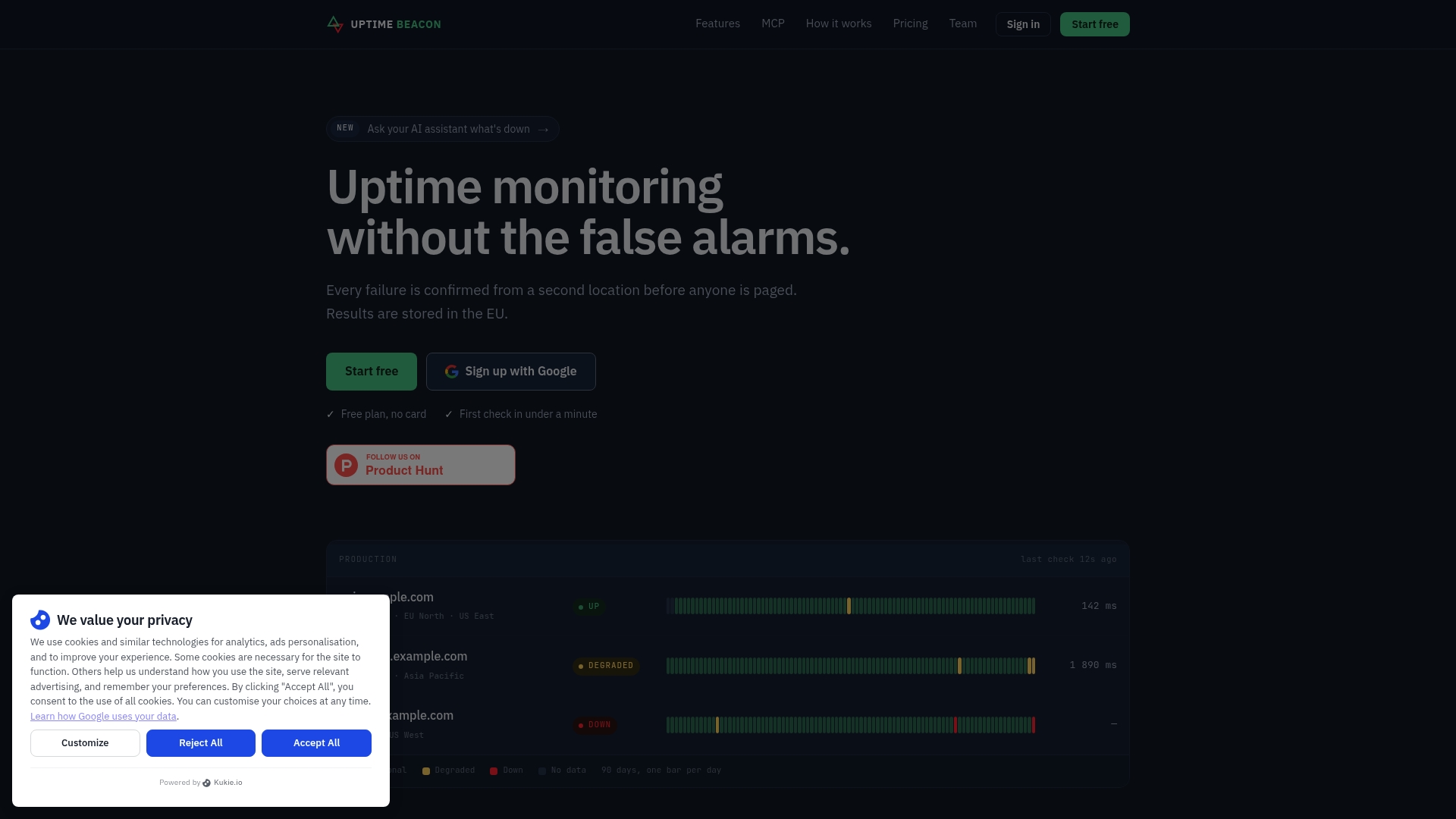
Create your free account on the Uptime Beacon homepage, and if you run an API-heavy product, see our page on API and cron monitoring for SaaS teams.
Our view: a status page is the last step, not the first
A status page is only as honest as the signal behind it. Most teams who outgrow Cachet are not really unhappy with the page. They are unhappy that a person has to notice the outage, decide it is real, and type an update while customers are already refreshing.
We built Uptime Beacon around the order of those steps. Detect first, with an incident that opens only after repeated failures confirmed from a second region, so the pager rings for real problems. Then communicate, from a page that does not rely on the dashboard being up. Then investigate, with an assistant that can read your monitors and diagnose the failure region by region over MCP.
Our founders have more than 30 years combined running production in banking, fintech, telecom and SaaS, and the product reflects that background: fewer pages in the night, and one less server to maintain. Whatever you pick, put detection and communication in the same loop.
Aaditya Parashar
FAQ
Is Cachet still maintained?
It is community-maintained. A March 2026 Unsubbed profile puts the last stable release in 2023, with the core team working on version 3.0. If you need predictable updates and security fixes, a hosted tool or an actively released project is easier to plan around.
Do I need monitoring as well as a status page?
Yes, because a page is only accurate if something detects the outage. Cachet and several hosted page tools do not check your services themselves. Uptime Beacon combines both, so incidents and the public page come from the same checks.
Is there a free Cachet alternative?
Yes. Uptime Beacon’s Free plan includes 5 monitors, one alert channel and one status page with no card. Self-hosted tools such as Uptime Kuma have free software, but you pay for the server and the time to run it.
Which option suits EU data residency requirements?
Uptime Beacon stores every result on a control plane and database in the EU. With self-hosted tools you can meet the requirement by choosing an EU region, but backups, access control and compliance stay your responsibility.
Sources
- FAUN.dev: Top 9 Cachet Alternatives and Competitors
- FAUN.dev: Checkly vs Uptime Kuma
- OpenTechHub: Uptime Kuma profile
- Unsubbed: Cachet profile
- Subrupt: Atlassian Statuspage alternatives
- Kurums: Best Status Page Software in 2026
- CostBench: Statuspage hidden costs
- Elestio: GDPR compliant hosting with EU data residency


