Incident Response Playbooks: First Hour Checklist and NIST Mapping
Build incident response playbooks with NIST CSF 2.0 mapping, SITM timing metrics, scenario templates, and a printable checklist for the first hour.
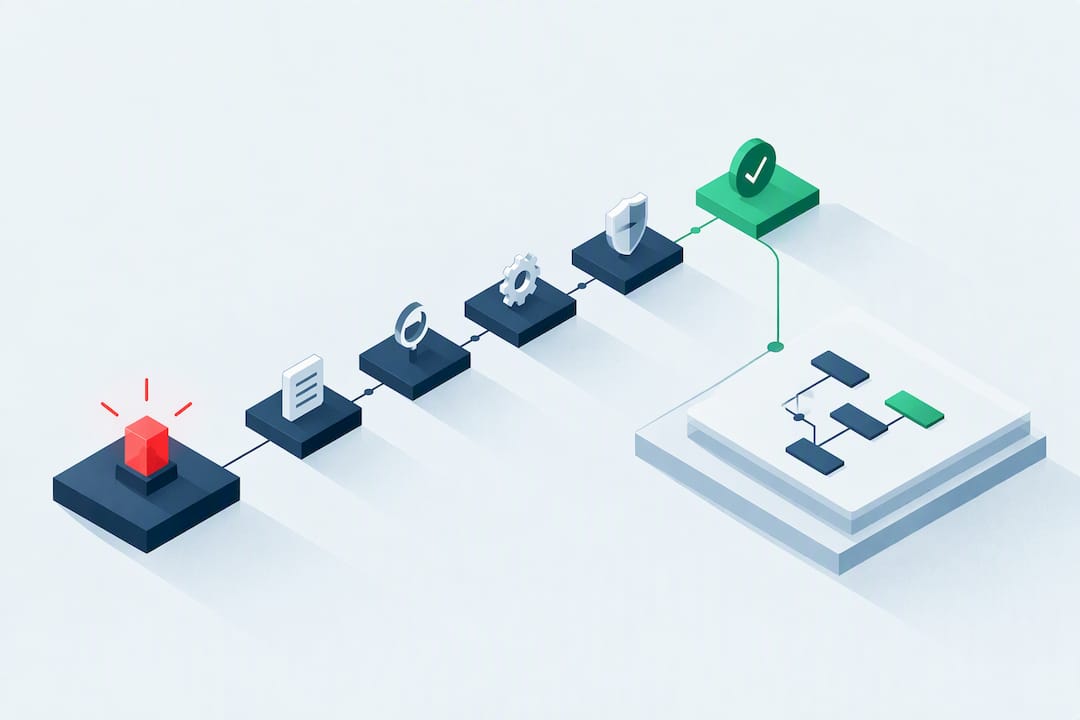
An incident response playbook is a scenario-specific, step-by-step set of procedures and checklists teams run during a security incident to detect, contain, eradicate, and recover with measurable timelines. Incident managers, technical leads, and on-call engineers use it so nobody improvises under pressure. If you need one now, copy the template below or jump straight to the scenario section for ransomware, phishing, or business email compromise.
TL;DR:
- Map each phase to NIST CSF 2.0 and verify prerequisites, authority, and controls exist; otherwise, containment steps may fail during a real incident.
- Prioritize scenarios using incident history and asset criticality, then give each a consistent trigger, containment, eradication, and recovery sequence tied to relevant MITRE ATT&CK techniques.
- Capture awareness, first response, containment, and remediation timestamps automatically, using one time zone and format so comparisons and retrospectives rely on consistent records.
- Keep playbooks in version control, run quarterly tabletop exercises and one annual full scale simulation, and assign an owner to record each exercise and revision.
- Set severity rules before incidents: a Sev 1 activates the full team and executives, while a Sev 3 may require only on call coverage and service owner sign off.
Table of Contents
- Core Playbook Template: Components Every Playbook Needs
- Mapping the Incident Lifecycle to NIST CSF 2.0
- Scenario Playbooks and MITRE Mapping
- Metrics and Timing: What to Track During Every Incident
- Build, Test, and Maintain Playbooks
- Actionable Playbook Index and First-Hour Checklist
- Where Monitoring Design Fits Inside a Playbook
- Coordinating With Vendors, Law Enforcement, and CERTs
- Legal and Compliance Considerations in Incident Response
- Automation and Orchestration Inside Your Playbooks
- Why Modular Playbooks and Blameless Retrospectives Actually Scale IR
- Reducing False Alarms With Multi-Location Monitoring
- FAQ
- Sources
Core Playbook Template: Components Every Playbook Needs
A playbook that actually gets used during a 2 AM page looks different from a policy document. CISA’s Cybersecurity Incident & Vulnerability Response Playbooks model the structure worth copying: operational procedures, a playbook index, and checklists built for the moment work actually happens, not for a compliance binder.
Each playbook needs:
- Header metadata: scope, document owner, version, and the date it was last exercised.
- Roles and contact matrix: Incident Manager, Technical Manager, Communications Manager, legal counsel, and external vendor contacts with phone numbers, not just email.
- Prerequisites and detection triggers: the logging sources, telemetry, and minimum evidence needed before the playbook is invoked.
- First-hour immediate actions: the safety checks and containment steps that happen before investigation deepens.
- Investigation, containment, eradication, and recovery sequences: ordered steps, not a narrative.
- Evidence preservation and post-incident tasks: chain-of-custody notes and the handoff to retrospective.
Microsoft Learn’s incident response playbooks follow this same pattern for scenarios like phishing and password spray, pairing prerequisites with a workflow diagram and a checklist that responders can follow without reading the whole thing twice.
Mapping the Incident Lifecycle to NIST CSF 2.0
NIST SP 800-61 Revision 3 repositions incident response as something integrated across all of CSF 2.0, not a bolt-on process that starts when something breaks. Playbooks work better when they’re organized around CSF functions instead of living as isolated documents.
- Govern, Identify, and Protect cover preparation: asset inventories, risk tolerance decisions, and access controls that determine what a playbook can assume is already true.
- Detect, Respond, and Recover make up the active lifecycle a playbook operates inside, from the first alert through service restoration.
- Improvement closes the loop: lessons learned from a real incident or a tabletop exercise feed back into governance decisions, updated asset data, and revised detection logic.
This mapping matters because a playbook written in isolation tends to assume detection capabilities or authority to act that don’t exist. Tying each playbook phase to a CSF function forces a gap check: if your “contain” step assumes network segmentation that Protect never implemented, the playbook will fail in production, not on paper.
Scenario Playbooks and MITRE Mapping
A single generic playbook can’t cover ransomware, phishing, and DDoS with the same steps. Build modular, scenario-specific playbooks instead, prioritized by likelihood and impact to your environment.
- Pick scenarios by exposure, not by what’s trending: rank threats using your own incident history, asset criticality, and industry patterns.
- Use a consistent skeleton: trigger conditions, scope definition, containment actions, eradication steps, and recovery criteria, in that order, for every scenario.
- Map detection and containment to MITRE ATT&CK techniques: a ransomware playbook should reference the specific techniques (initial access, lateral movement, impact) your hunts and alerts are built to catch.
- Write scenario checklists as discrete actions: a ransomware playbook isolates affected hosts and preserves volatile memory; a phishing playbook disables compromised credentials and pulls the malicious message from all mailboxes; a BEC playbook freezes pending wire transfers and notifies the bank’s fraud unit immediately.
Keeping each scenario modular means a responder opens one document, not a 40-page manual, when the clock starts.
Metrics and Timing: What to Track During Every Incident
FIRST’s Security Incident Timing Metrics (SITM) v1.0 defines standardized timeline records that four key metrics are derived from, reducing the ambiguity that makes MTTA and MTTR comparisons meaningless across teams. The four records worth capturing in every incident are time of awareness, time of first response, time to contain, and time to remediate or resolve.
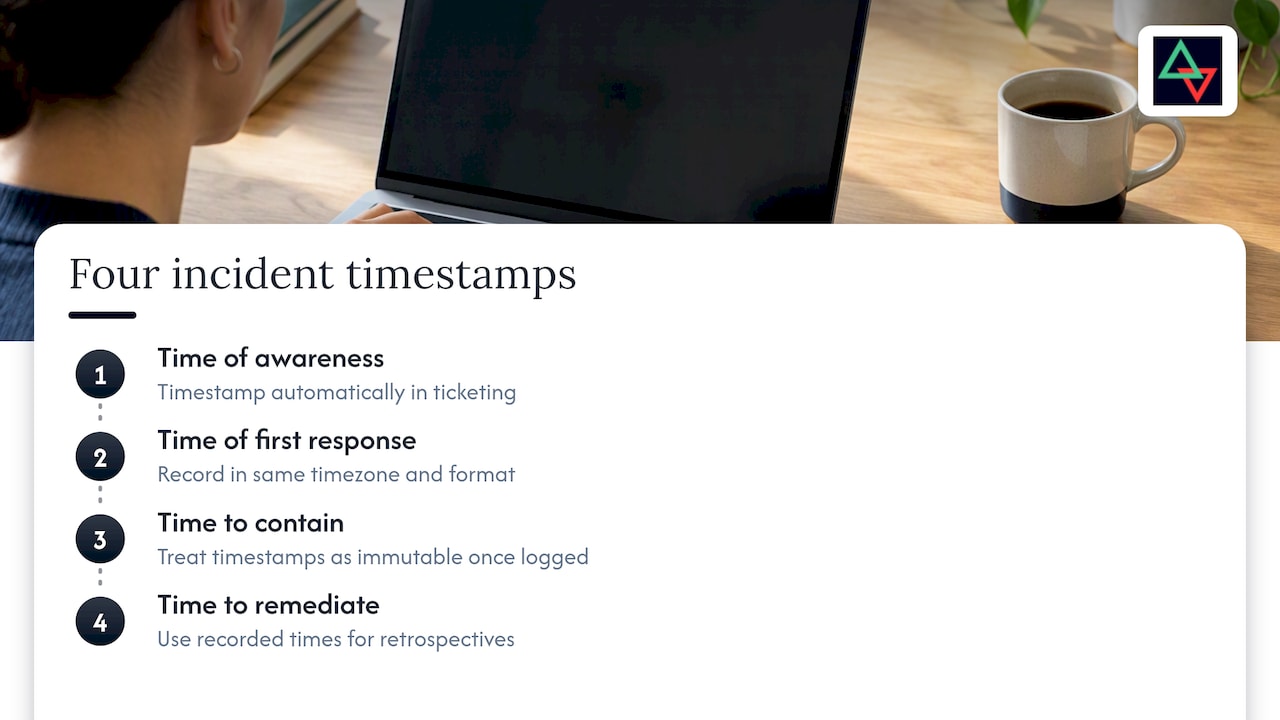
Capture these automatically where possible: ticketing systems and alerting tools should timestamp events rather than relying on a responder’s memory after the fact. Use one timezone and one format across your organization, and treat the timestamps as immutable once logged. These records become the backbone of retrospectives and of any reporting to leadership, since a playbook’s real performance shows up in how fast awareness turned into containment, not in whether the document existed.
Build, Test, and Maintain Playbooks
A playbook that’s never been run is a guess. Treat authoring and testing as one continuous process.
- Author in version control: playbooks live as tracked files, not static PDFs, so changes are reviewable and the history is visible.
- Exercise on a cadence: run tabletop exercises quarterly and at least one full-scale simulation annually, per the readiness guidance in CISA’s Incident Response Plan Basics.
- Run blameless retrospectives: focus on what the playbook missed, not who missed it, and convert every finding into a specific edit.
- Update the last-exercised date on the playbook itself and assign an owner responsible for the next revision.
Pro Tip: Add a single “last exercised” field to every playbook header; teams that track it consistently run exercises more often because the gap becomes visible at a glance.
Actionable Playbook Index and First-Hour Checklist
Keep a short, indexed list of every playbook so responders can find the right one in seconds, following the modular approach OpenCDC’s incident response plan template recommends, where the IRP stays strategic and short while tactical steps live in separate files.
| PB-ID | Scenario | First action | Owner |
|---|---|---|---|
| PB-01 | Ransomware | Isolate affected hosts | Technical Manager |
| — | Phishing | Disable compromised credentials | Incident Manager |
| — | BEC | Freeze pending transfers | Communications Manager |
| — | DDoS | Engage upstream provider | Technical Manager |
Adapt the first-hour checklist by severity: a Sev-1 triggers full team activation and executive notification, while a Sev-3 may only need the on-call engineer and a documented sign-off from the affected service owner before closing.
Where Monitoring Design Fits Inside a Playbook
Detection prerequisites belong in the playbook itself, not in a separate monitoring wiki. The section should state exactly what confirms an incident is real before anyone gets paged.
- Write confirmation logic explicitly: specify whether an alert requires a single check or confirmation from a second, independent location before it counts as a real failure.
- Secondary-location confirmation cuts false pages: a failure confirmed from two vantage points gets a responder moving on a real problem instead of a transient network blip.
- Record operational constraints: note where monitoring data is stored (useful when data residency rules apply) and whether your status page can stay reachable during an actual outage, since a status page hosted on the same infrastructure that just failed tells nobody anything.
Documenting these details inside the playbook means a new on-call engineer understands not just what to do, but why the alert fired in the first place.
Coordinating With Vendors, Law Enforcement, and CERTs
Most serious incidents outgrow a single team’s authority to act. The playbook’s contact matrix needs more than internal names: it needs the external parties who get pulled in once scope expands.
Cloud and SaaS vendors often hold logs or forensic data you can’t access directly, so their incident contact and SLA for data requests belong in the playbook, not discovered mid-incident. CISA’s Incident Response Plan Basics recommends meeting local law enforcement and regional CISA teams before an incident happens, since introductions made during an active breach cost time you don’t have.
Decide in advance which incident types trigger a law enforcement report: ransomware with extortion, suspected nation-state activity, or theft of regulated data typically warrant it, while a contained phishing attempt usually doesn’t. National CERTs and sector-specific information sharing groups can also provide threat intelligence or coordinate disclosure timing when an incident affects multiple organizations, and the playbook should name which CERT applies to your jurisdiction and sector.
Keep a standing list of these contacts separate from your general vendor directory, reviewed at the same cadence as your tabletop exercises, since vendor account managers and law enforcement liaisons change roles more often than the playbook gets updated otherwise. When outside parties are engaged, the Communications Manager role should own the relationship so technical responders stay focused on containment instead of fielding external calls. Document what information can be shared externally and what requires legal sign-off first, since oversharing technical detail during an active incident can complicate both the investigation and any later legal proceedings.
Legal and Compliance Considerations in Incident Response
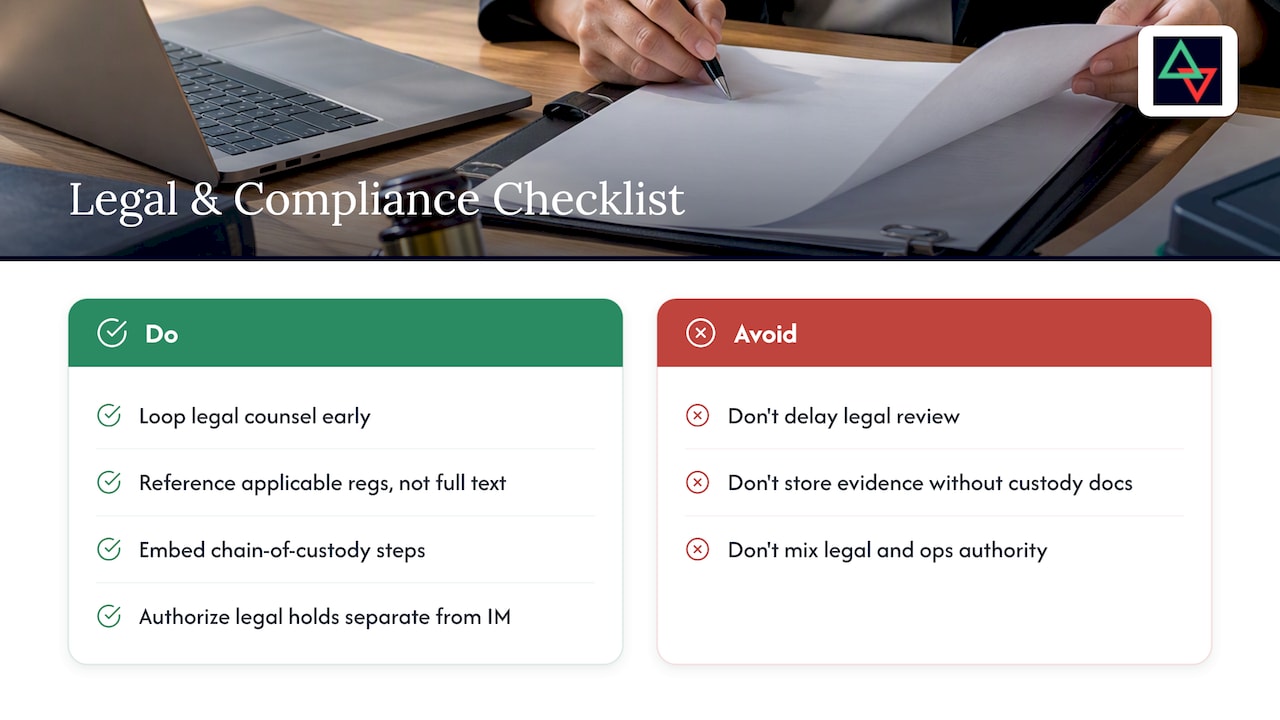
Legal review belongs earlier in the process than most teams place it. Breach notification laws vary significantly by jurisdiction and by the type of data involved, so the playbook should flag, as a prerequisite step, when legal counsel needs to be looped in rather than leaving that judgment call to whoever is on shift.
Regulated industries carry specific obligations: financial services, healthcare, and telecom each have sector rules about what must be reported, to whom, and on what timeline. Rather than embedding full legal text into a playbook, reference the applicable regulation and point to counsel for the current requirement, since laws change more often than playbooks get revised.
Evidence handling has legal weight beyond the technical investigation. Chain-of-custody documentation, especially for anything that might support a law enforcement referral or civil action, needs to be built into the containment and eradication steps, not added afterward. Specify who is authorized to make legal holds on data and systems, and keep that authority separate from the Incident Manager’s operational role so coordination and legal decisions don’t get tangled together.
Cross-border incidents add another layer: data residency rules can determine where evidence can legally be stored or transferred during an investigation, and a playbook that ignores this can create compliance exposure on top of the original incident. For smaller organizations without in-house counsel, mapping these governance steps to a managed framework, like the NIST-mapped cybersecurity planning guidance from NEXTmsp, can clarify which legal and compliance tasks to prioritize first.
Automation and Orchestration Inside Your Playbooks
Manual execution of a playbook under time pressure introduces errors that automation can remove. Security orchestration, automation, and response (SOAR) platforms let you encode repeatable steps, like isolating a host, disabling a credential, or opening a ticket, so a responder triggers the action instead of typing commands from memory.
Automation works best on the steps that are deterministic and low-risk to execute without human review: credential disablement, network isolation of a confirmed-compromised host, and evidence collection from known log sources. Steps that require judgment, like deciding whether to pay a ransom demand or notify a regulator, should stay manual, with the playbook clearly marking which category each step falls into.
Orchestration also solves a coordination problem: when a playbook triggers actions across multiple tools (EDR, firewall, identity provider), automation keeps those systems in sync instead of relying on a human to update each one separately during a high-stress incident. FIRST’s CSIRT Services Framework describes mitigation and recovery as a defined service function, and automation is what makes that function repeatable at scale rather than dependent on one person’s memory of the last incident.
The tradeoff is maintenance: an automated playbook step breaks silently if the underlying API or tool changes, so automated steps need the same version control and periodic testing as the manual procedures they replace. Treat automation as an accelerant for steps you’ve already proven work by hand, not a replacement for writing the procedure in the first place.
Why Modular Playbooks and Blameless Retrospectives Actually Scale IR
Teams that treat playbooks as living, modular files instead of a single master document adapt faster when a new attack pattern shows up. Blameless retrospectives are what make that adaptation real: they surface the gap between what the playbook assumed and what actually happened, without anyone getting defensive about it. Share your scenario templates and adaptation notes with peer teams; incident response improves faster when playbooks aren’t reinvented from scratch everywhere.
— Aaditya Parashar
Reducing False Alarms With Multi-Location Monitoring
Detection prerequisites in a playbook are only as good as the alerts feeding them. We built Uptime Beacon around one specific problem: on-call engineers getting paged for failures that resolve themselves before anyone can act.
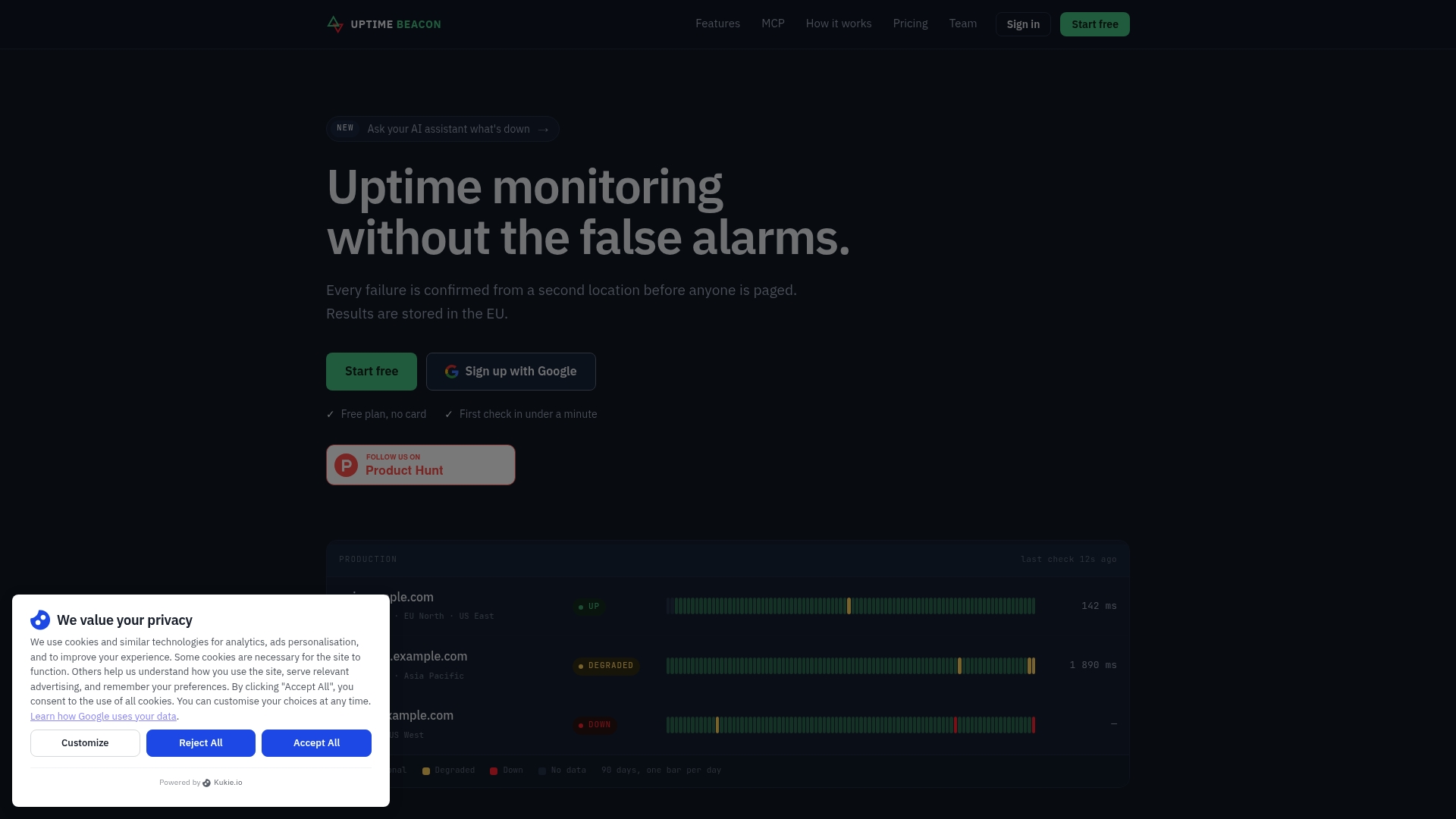
- We confirm every failure from a second location before sending an alert, cutting down pages triggered by transient network blips.
- Our service stores monitoring data within the EU, which matters when your playbook has to document data residency.
- The status pages remain reachable even during platform outages, so stakeholders get real information while you work the incident.
If your playbook’s detection prerequisites need a monitoring layer built for this, check our Free, Starter, and Pro plans and pick the tier that fits your monitor count.
FAQ
What is a playbook in incident response?
A playbook is a scenario-specific set of step-by-step procedures and checklists that responders follow to detect, contain, eradicate, and recover from a particular type of incident, such as ransomware or phishing. It differs from an incident response plan (IRP) by staying tactical and operational rather than strategic, per the modular structure OpenCDC’s template recommends.
What are the 7 steps of incident response?
Different frameworks number the phases differently, so there’s no single universal number of steps; some guides split preparation, detection, containment, eradication, recovery, and lessons learned into additional sub-steps. NIST SP 800-61 Revision 3 instead maps incident response across the CSF 2.0 functions of Govern, Identify, Protect, Detect, Respond, and Recover.
What are the 5 steps of incident response?
A common five-step version covers preparation, detection and analysis, containment, eradication and recovery, and post-incident activity. CISA’s Cybersecurity Incident & Vulnerability Response Playbooks structure their operational guidance around this same general sequence.
What are the 5 C’s of incident management?
There’s no single authoritative “5 C’s” framework for incident management in the sources we rely on, and definitions vary across vendors and training programs. Rather than citing an unverified list, focus your playbook on the roles and sequence that matter most: clear communication, a defined chain of command, and documented containment steps, all of which appear consistently across NIST and CISA guidance.
Sources
- Incident Response Recommendations and Considerations for Cybersecurity Risk Management: A CSF 2.0 Community Profile (NIST SP 800-61r3)
- Cybersecurity Incident & Vulnerability Response Playbooks (CISA)
- Security Incident Timing Metrics v1.0 (FIRST)
- Incident response playbooks | Microsoft Learn