AI Incident Response for On Call Teams: Confirm at Two Locations
See how on call teams can reduce false alerts with checks from multiple locations, causal context, human review, and EU data residency for AI triage.
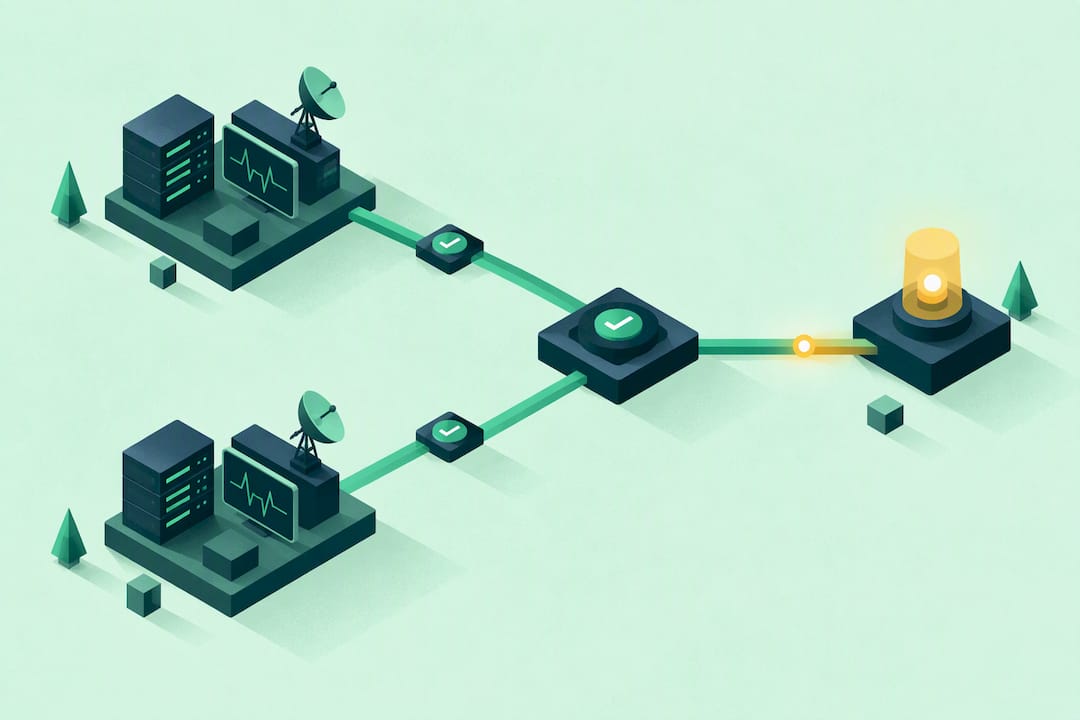
AI-assisted incident response works best as an enrichment and triage layer sitting on top of confirmed failures, never as an autonomous first responder. The pattern we recommend is simple: confirm the failure from a second location, enrich the alert with context, let a human review before anything acts on production. Multi-location confirmers like the one we build at Uptime Beacon exist precisely to feed that pipeline clean signal instead of noise, and storing results inside the EU keeps the whole chain compliant for teams that need it.
TL;DR:
The causal knowledge layer cut mean diagnostic time by about 63% and raised root cause accuracy from 75% to 100% across benchmarked runs.
Filter flapping checks and maintenance windows, then require confirmation from a second location before enriching alerts with deployments, dependencies, logs, traces, and SLO impact.
The OpsAgent deployment reached about 97% accuracy and diagnosed routine incidents in roughly 30 seconds, but harder cases still needed human review.
Begin with low risk incident classes, spend at least two weeks tuning suppression rules and tracking hallucinations and model costs, then expand gradually.
Table of Contents
-
How AI speeds triage: strengths, limits, and why uptime monitoring matters
-
Concrete steps to implement AI-assisted triage integrated with uptime checks
-
Architectural patterns that improve accuracy and auditability
-
Checklist engineers should verify before enabling AI-assisted routing
-
Where Uptime Beacon fits: confirmation, residency, and status-page resilience
How AI speeds triage: strengths, limits, and why uptime monitoring matters
AI earns its keep by pulling together everything an on-call engineer would otherwise have to chase down manually: logs, metrics, recent deployment events, and the history of similar past incidents. Google’s own SRE guidance describes this as an “investigation agent” that queries many data sources inside a tight time budget and hands the engineer a concise incident hypothesis along with verification steps, rather than acting on its own, according to Google SRE’s AI engineering guidance.
Where AI falls short is creativity and judgment under ambiguity: deciding whether a mitigation is safe to run against a crown-jewel system is still a human call.

A causal knowledge layer changes the economics of this work. The Causely benchmark on causal intelligence found that giving agents a persistent causal layer, rather than raw telemetry, cut mean time-to-diagnosis by about 63% and raised root-cause accuracy from 75% to 100% across benchmarked runs.
Uptime monitoring plays a quieter but equally important role here: every alert that gets confirmed as real before it reaches a human or a model is one less distraction competing for attention and token budget.
-
AI aggregates logs, metrics, deployments, and incident history faster than a human can manually correlate them.
-
Structured causal context, not more raw data, is what drives the largest accuracy gains.
-
Pre-confirmed failures mean less wasted triage time on both the human and AI side.
Concrete steps to implement AI-assisted triage integrated with uptime checks
Standing up an AI triage layer safely is a sequencing problem before it is a modeling problem. Each step below reduces the noise and risk the next step has to deal with.
-
Pre-filter known noisy alerts in your alerting rules so flapping checks and expected maintenance windows never reach the pipeline.
-
Require multi-location confirmation (a second check from a different vantage point) so only genuinely failing services generate an incident.
-
Enrich each confirmed alert with the SLO slice it affects, recent deployments, the dependency graph, and recent error logs and traces.
-
Feed the model structured context instead of raw telemetry dumps: a causal or knowledge layer cuts token use and reduces the chance the model invents a root cause that is not there.
-
Define progressive authorization levels: allow partial automation (tagging, routing, drafting a summary) at a lower tier, but require explicit human approval before any action that touches production state.
-
Roll out in stages, starting with low-risk incident classes, and spend at least two weeks tuning suppression rules and watching for hallucinations and unexpected model cost before expanding scope.
The OpsAgent deployment study backs the staged approach: its multi-agent system reached about 97% accuracy and diagnosed common, routine incidents in roughly 30 seconds, while harder cases still relied on human review, a split that matches the confirm-enrich-review pattern described in the OpsAgent multi-agent incident management paper.
Pro Tip: Log every AI-suggested action and whether a human approved, modified, or rejected it. That record becomes your best source of prompt and suppression-rule improvements later.
Architectural patterns that improve accuracy and auditability
Three patterns show up repeatedly in production-grade deployments, and each solves a different part of the accuracy and trust problem.
A causal intelligence or knowledge layer stores topology, service dependencies, and typed relationships (a service depends on a cache, a cache depends on a region) so agents never have to reconstruct that state from scratch on every incident. The Causely benchmark found this grounding reduced diagnosis tokens and latency substantially while pushing root-cause accuracy to 100% on tested categories, as reported in the causal intelligence benchmark.
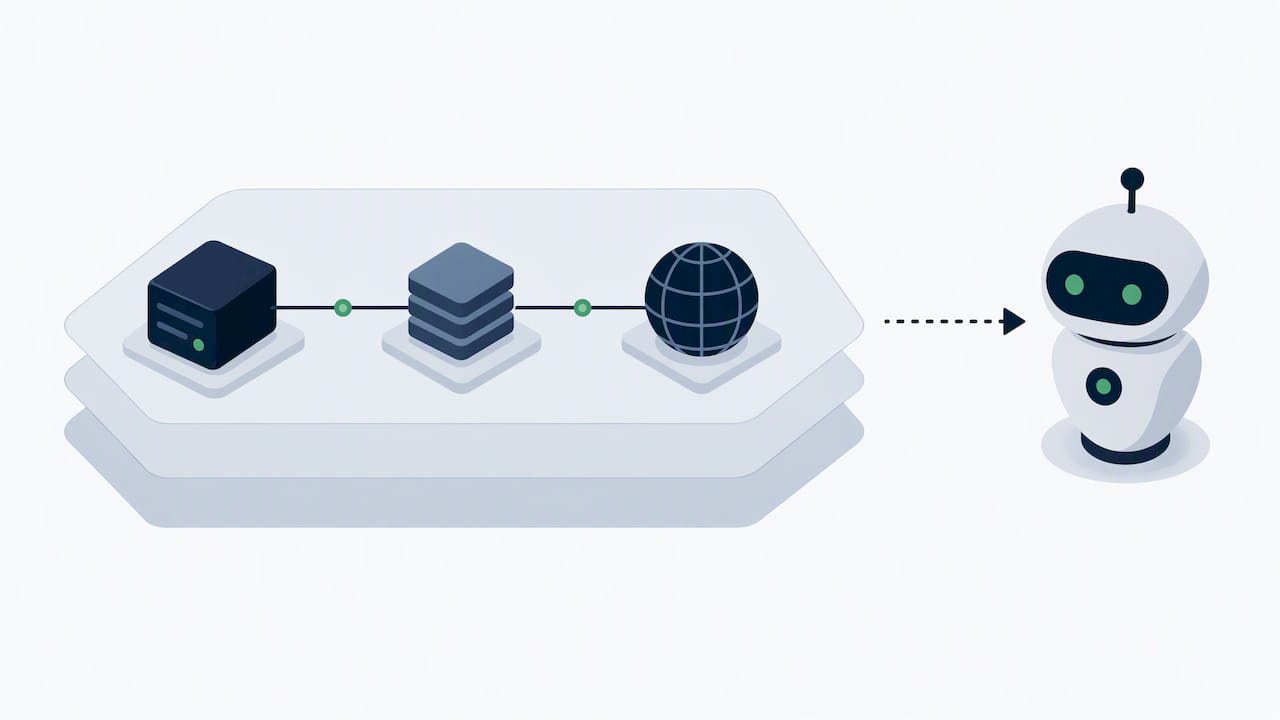
Multi-agent orchestration splits the work into roles: one agent flags anomalies, another triages likely failure modes, a third localizes root cause, and an orchestrator reconciles their findings into an auditable chain of reasoning. This mirrors how human incident teams already divide labor and makes the AI’s reasoning easier to review after the fact, a structure the OpsAgent paper credits for both interpretability and continual improvement.
Retrieval-augmented generation paired with an investigation dashboard surfaces synthesized evidence and suggested verification steps directly where the on-call engineer is already looking, rather than in a separate chat window.
-
Causal layer: typed dependencies, recent deployments, and a reliable “no active root cause” signal.
-
Multi-agent split: anomaly detection, triage, and root-cause localization reviewed by an orchestrator.
-
RAG dashboard: evidence and next steps shown inline in the on-call UI.
-
Automated actuation: scoped only to low-risk, reversible actions with logged approval.
Checklist engineers should verify before enabling AI-assisted routing
Before any alert reaches a model, confirm the inputs and guardrails are actually in place.
-
Confirmers: multi-location checks are configured and validated, so a secondary location confirms an outage before anything downstream fires.
-
Context feeds: deployments, logs, traces, the dependency graph, and SLO slices are wired into the enrichment pipeline, not bolted on later.
-
Authorization: approval gates, dry-run modes, and rollback controls are built into the runbooks the AI references, not left as tribal knowledge.
-
Observability: you are tracking mean time to detect, mean time to resolve, false-alert rate, hallucination incidents, and model call cost as ongoing metrics.
-
Compliance: data residency and retention settings match your regulatory needs, with EU residency available for teams that require it.
Skipping any one of these tends to show up later as either alert fatigue or a model confidently acting on bad information.
Practitioner takeaways and realistic expectations
AI cuts toil and triage time, but it is only as good as the rollbacks and runbooks behind it: a fast diagnosis still needs a fast, safe mitigation to matter. Resist routing every alert through a model. Pre-filtering saves cost and keeps the signal-to-noise ratio high enough that engineers trust what they see. The most durable gains come from treating every incident and postmortem as an input: tighten suppression rules, expand the causal graph, and rewrite prompts based on what actually went wrong last time.
— Adi
Where Uptime Beacon fits: confirmation, residency, and status-page resilience
We built Uptime Beacon around the first and most consequential step in this whole pipeline: making sure an alert is real before it goes anywhere. Every failure gets confirmed from a second location before we notify anyone, which means the AI layer downstream, and the human reviewing it, spend time on genuine incidents instead of transient issues.
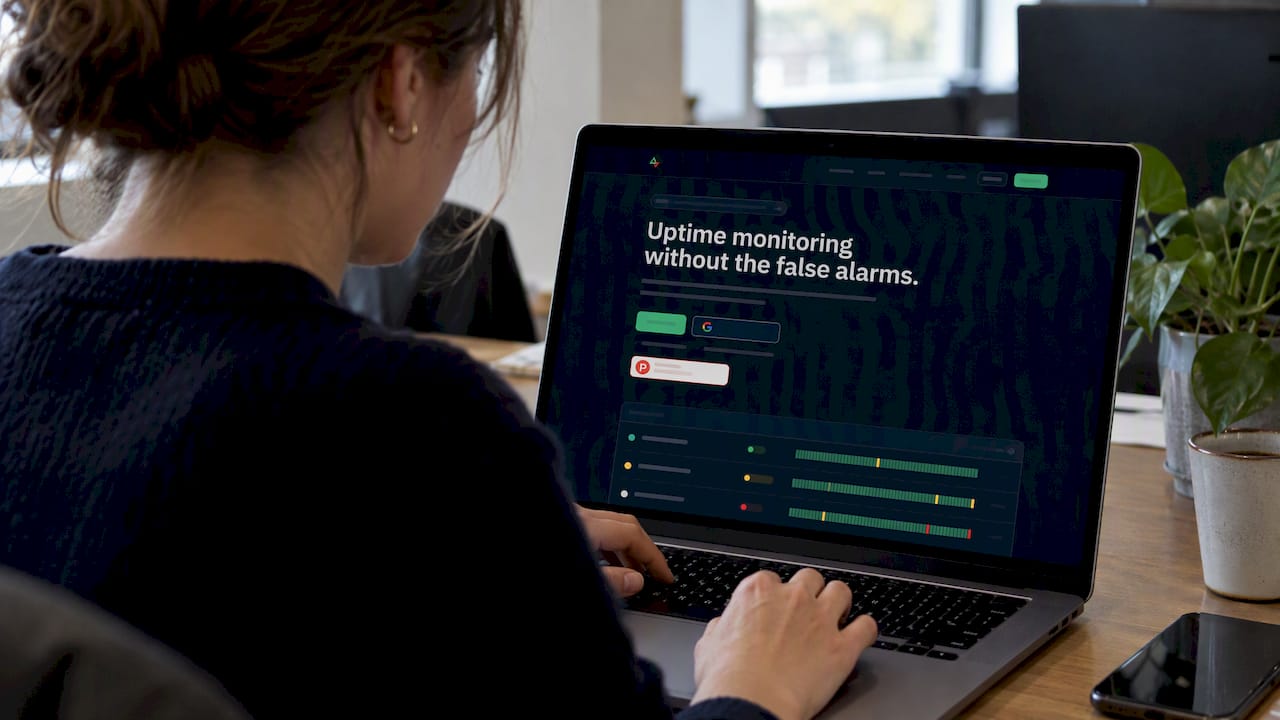
For teams with compliance requirements, we store all monitoring data inside the EU, so residency never becomes a separate project. Our status pages stay operational even during a platform outage, and we connect to the tools already in your incident workflow through webhooks, Slack, and our API. If you want to see how confirmed alerts look before they ever reach a model, our Free, Starter, Pro and other plans are listed on our pricing page, starting with a Free tier and moving up to Starter at €14.99 per month, Pro at €39.99 per month, and Business at €89.99 per month.
FAQ
What is AI-assisted incident response in production systems?
It is the use of AI to aggregate logs, metrics, deployments, and past incidents into a concise hypothesis for an on-call engineer, rather than full autonomous handling. Google SRE guidance frames this as an investigation agent that surfaces evidence and verification steps, with humans retaining control over any risky action, according to Google’s AI engineering practices.
How does AI reduce false positives in alerting?
AI itself does not eliminate false positives; confirming failures from a second location before an alert fires does, which keeps noisy transient issues out of the pipeline entirely. Pairing that confirmation step with suppression rules tuned over a settling period further reduces how much noise ever reaches a model or a human.
What metrics show whether AI incident response is working?
Track mean time to detect, mean time to resolve, false-alert rate, and model-specific figures like hallucination incidents and call cost. The OpsAgent deployment study reported around 97% accuracy and roughly 30-second diagnosis times for routine incidents, a useful benchmark for what “working” looks like on common cases.
How does a causal knowledge layer improve AI accuracy?
A causal layer gives agents typed dependency relationships and recent deployment events instead of raw telemetry, so they do not have to reconstruct system state from scratch. Benchmark testing found this cut mean time-to-diagnosis by about 63% and raised root-cause accuracy from 75% to 100% in tested scenarios, per the causal intelligence study.
Should AI be allowed to take automated action during an incident?
Only for narrowly scoped, reversible, low-risk actions with logged approval gates and dry-run testing beforehand. Practitioner guidance from Google SRE’s debugging practices and its own incident response discussions consistently treats AI as a tool that removes toil rather than one trusted with full autonomous control over critical systems.