Root Cause Analysis: 8 Steps to Verify What Went Wrong
Follow eight root cause analysis steps to preserve incident evidence, test suspected causes, choose corrective actions, and confirm that fixes work.

Root cause analysis is a structured, evidence-driven investigation that identifies the underlying management or process failings behind a problem, not just its immediate trigger. The workflow runs in six stages: define the problem, collect evidence, analyze causal factors, verify suspected causes, implement corrective actions, and measure whether they worked. A full RCA is worth the effort for recurring or high-consequence events; a one-off, low-risk issue usually needs only a quick correction.
TL;DR:
Use 5 Whys for a clear single cause, fishbone diagrams for many possible factors, and fault tree analysis for interacting failure modes.
Capture logs, configurations, timestamps, and witness details immediately, then test each suspected cause against a competing explanation before marking it verified.
Give every corrective action an owner, deadline, success measure, and review date; favor automated controls or redesigned workflows over training and reminders.
Some healthcare frameworks expect formal reviews within 45 days, while isolated issues that pose little risk can go straight to quick correction.
Table of Contents
-
The step-by-step RCA process and what to deliver at each stage
-
Which RCA method fits your problem: 5 Whys, Fishbone, Pareto, and more
-
Turning verified root causes into corrective actions that stick
-
Building an RCA team that investigates without assigning blame
-
Why monitoring quality shapes how fast you can verify a cause
-
What experienced practitioners get wrong about root cause analysis
The step-by-step RCA process and what to deliver at each stage
A repeatable RCA follows a defined sequence, and each step has a concrete output rather than a vague milestone.
Start with the groundwork: a written charter naming the facilitator, team members, and scope sets expectations and keeps the investigation from turning into a blame exercise. Confidentiality rules, agreed up front, encourage people to describe what actually happened rather than a defensive version of events.
-
Define the problem using an object, a measured gap, a time window, and an Is/Is Not comparison that separates where the problem occurred from where it did not.
-
Contain and preserve evidence immediately: stop further damage where safe to do so, and capture logs, configurations, and system states before they are overwritten.
-
Collect data through a structured checklist and build an initial timeline or flow diagram of events.
-
Generate candidate causes and map contributing factors against the timeline.
-
Verify suspected causes against evidence rather than assuming the most plausible one is correct.
-
Select root causes and write them as root cause and causal factor statements, following the five rules of causation used in formal RCA guidance.
-
Develop actions, assign owners and deadlines, and define measurable outcomes.
-
Review effectiveness on a set cadence and close the investigation once the measure confirms the fix held.
Good problem statements are factual, measurable, and free of assumed causes, since a solution-biased problem statement narrows the investigation before it starts. A statement like “response time degraded 40% between 2:00 and 2:45 AM on the payments API” gives the team something to test; “the database was misconfigured” does not.
Deliverables worth keeping in the file:
-
A signed charter naming facilitator, scope, and team.
-
An initial and a final flow diagram or event-and-causal-factor chart.
-
Verified root cause and causal factor statements.
-
An action tracking table with owners, dates, and success measures.
Pro Tip: Freeze your evidence collection checklist before the investigation starts. Deciding what to capture mid-incident means you will forget something.
Which RCA method fits your problem: 5 Whys, Fishbone, Pareto, and more
No single technique covers every situation. Matching the method to the complexity and risk of the problem saves time and produces a sharper answer.
-
5 Whys works for straightforward, single-thread problems where asking “why” repeatedly traces a clear causal chain quickly.
-
Fishbone (Ishikawa) diagrams organize many candidate causes across categories like people, process, equipment, and environment, useful when a problem could stem from several directions at once.
-
Pareto charts rank contributing factors by frequency or impact, helping teams decide where to invest investigative depth first.
-
Change analysis compares a normal operating state against the point things went wrong, useful when something changed recently but nobody is sure what.
-
Barrier analysis examines which safeguards should have stopped the problem and why they didn’t.
-
Fault tree analysis works top down from the failure to its possible contributing combinations, suited to complex systems with multiple interacting failure modes.
-
Event and causal factor charting (ECFA) lays out a detailed timeline against contributing conditions, often used in formal incident investigations.
These tools work best combined rather than used in isolation. A team might use a Pareto chart to decide which of five recurring outage types deserves a full fishbone session, then use change analysis to narrow the causes before building a fault tree for the surviving candidates. The common RCA toolkit cited across current practice treats these methods as complementary, selected by problem complexity rather than by habit.
Collecting and verifying evidence before you trust a cause
Evidence quality determines whether an RCA produces a defensible answer or a guess dressed up as one.
Capture immediately, before memory or systems drift:
-
Logs, error traces, and system snapshots from the incident window.
-
Configuration settings and recent change records.
-
Witness names and contact details while memories are fresh.
-
Precise timestamps for every observed event.
Build an initial flow diagram as soon as evidence starts coming in, then refine it into a final version once causal factors are mapped. An event-and-causal-factor chart improves investigation rigor by forcing the team to show, not assume, how one event led to the next.
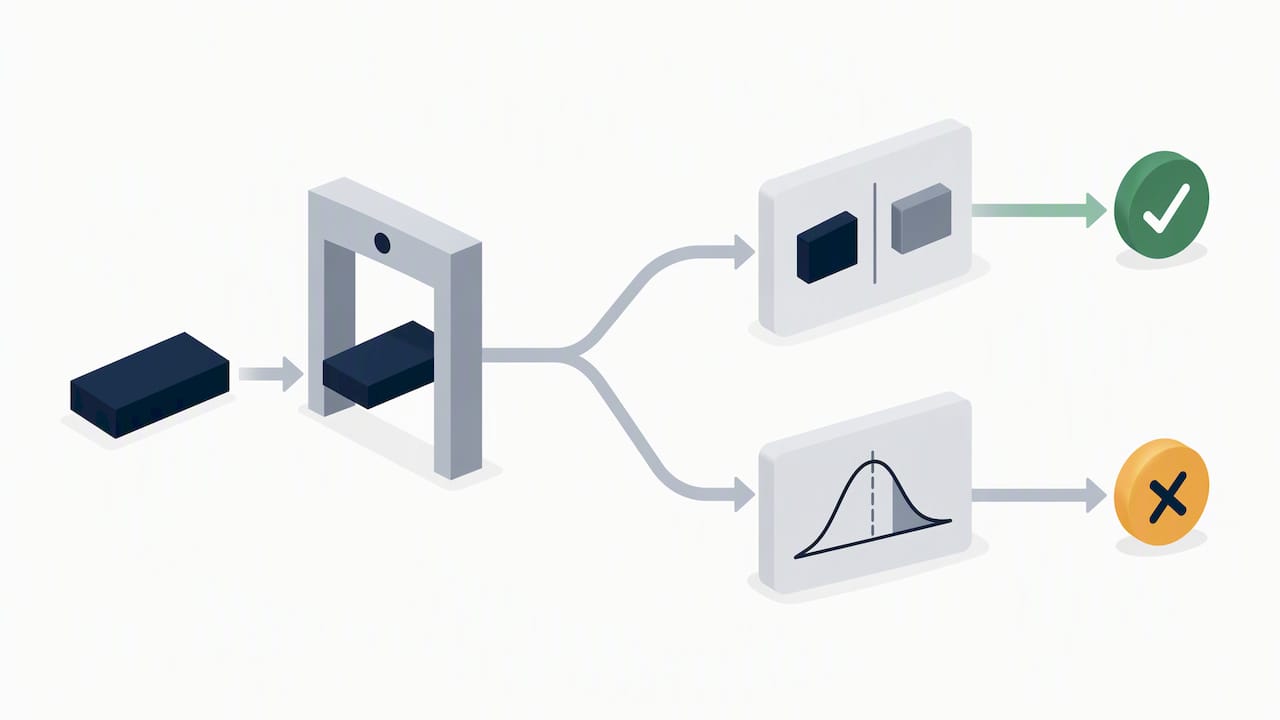
A suspected cause earns the label “verified” only after a test: reproducing the failure under controlled conditions, comparing records against a competing explanation, or running a statistical check where volume allows. A cause that cannot survive a direct test should stay a hypothesis, not become the basis for a corrective action.
Pro Tip: Log what you ruled out, not just what you confirmed. A record of rejected hypotheses protects the next investigation from retesting dead ends.
Turning verified root causes into corrective actions that stick
A verified root cause is only useful once it becomes an action someone owns and a result someone can measure.
Write each action with four parts: what changes, who owns it, how success is measured, and the deadline. “Add a code review step” is weaker than “require a second engineer’s sign-off on payment-service deploys, owned by the platform lead, measured by zero unreviewed deploys over the next quarter, due in two weeks.”
-
Favor engineering controls and process redesign over reminders or retraining, since forcing functions remove the chance of repeat human error.
-
Rank candidate actions by strength: a system that makes the error physically impossible beats a checklist, which beats a one-time briefing.
-
Assign an outcome metric and a monitoring period that matches the risk, longer for safety-critical systems, shorter for low-impact ones.
-
Set a review date to confirm the metric held, not just that the action was completed.
Action strength matters more than action count:
-
Strong: automated validation, hardware interlocks, redesigned workflows.
-
Medium: forced checklists, mandatory approvals.
-
Weak: training sessions, verbal reminders, policy memos.
If the effectiveness review shows the metric didn’t move, treat that as new evidence and return to verification rather than closing the case on hope.
Building an RCA team that investigates without assigning blame
The team composition shapes whether people tell the truth about what happened.
A core team typically includes someone close to the process, an engineer or technical specialist, and a quality or safety representative; add a human factors specialist when the event involves judgment calls under pressure. Cross-functional teams with strong facilitation produce more defensible RCAs than single-discipline reviews.
The facilitator carries specific duties:
-
Keep the charter and agenda visible so the session doesn’t drift into unrelated grievances.
-
Insist on evidence before conclusions, redirecting the room when someone jumps straight to a fix.
-
Watch for solution bias, the instinct to settle on a familiar answer rather than test the unfamiliar one.
-
Run interviews that protect psychological safety, asking what happened rather than who is responsible.
Timelines matter too. Some healthcare RCA frameworks expect formal reviews completed within 45 days of the triggering event, which keeps evidence fresh and momentum intact. Lower-risk or one-off issues rarely need that formal structure; triage rules should route them to a quick correction instead.
Templates and checklists worth keeping on hand
Reusable templates cut the setup time for every future RCA.
A problem statement template needs five fields: the object affected, the measured gap, where and when it occurred, the affected population, and an Is/Is Not comparison.
An evidence checklist should prompt the team for:
-
System logs and error traces from the incident window.
-
Screenshots or snapshots of relevant configurations.
-
Witness statements captured within days, not weeks.
A verification checklist records each test run against a suspected cause, with a clear pass or fail result and the date tested.
-
List the root cause and its supporting evidence.
-
Name the corrective action and its owner.
-
Record the due date and the outcome measure.
-
Note the verification evidence confirming the fix held.
Keeping these four documents together with the final report turns a one-time investigation into a repeatable playbook.
Why monitoring quality shapes how fast you can verify a cause
The evidence that feeds an RCA is only as good as the detection system that generated it. A monitoring setup that pages on every transient blip buries real incidents under noise, and a team sorting through false alarms loses the clean timeline an RCA depends on.
Confirming a failure from a second location before raising an alert keeps the incident record limited to events that actually happened, which matters when the investigation starts from “what triggered this” rather than “was this even real.” Status pages that stay reachable during an outage, and incident logs stored within a defined region for teams under data residency rules, give investigators a continuous record instead of a gap exactly when evidence matters most.
-
Multi-location confirmation reduces the false positives that dilute an incident timeline before analysis starts.
-
A status page that works during an outage preserves the timestamp record investigators rely on.
-
EU-resident logs support audit trails for regulated teams working under data residency requirements.
A practical habit for RCA teams: fold monitoring alerts and incident timestamps directly into your evidence checklist so verification starts from a confirmed record rather than a raw alert feed.
What experienced practitioners get wrong about root cause analysis
The most common failure isn’t a bad method, it’s stopping at the first plausible cause and calling it done. A cause that sounds right still needs at least one verification test before it earns a place in the final report.
The second failure is silence after closure: teams fix the issue, then never document what they learned or share it with anyone outside the room. Writing it down and circulating it is what turns one RCA into protection for the next incident.
— Adi
A faster path to reliable incident evidence
Clean evidence makes every RCA step above easier, and that’s the gap we built Uptime Beacon to close. Every failure detected gets confirmed from a second location before an alert is raised, so incident timelines reflect real outages instead of transient network noise. Monitoring data can stay within the EU, helping regulated teams preserve audit trails, and status pages can remain operational even during system outages.
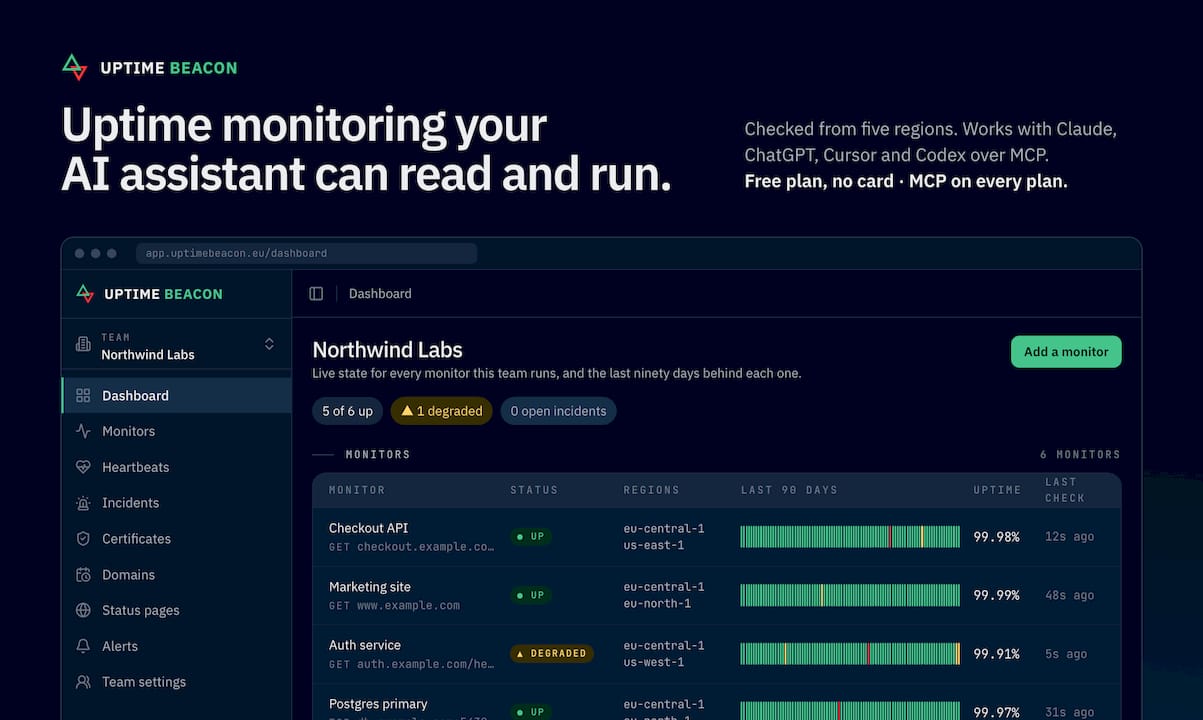
If your team is tired of starting RCAs from a messy alert history, check our Free, Starter, Pro and other plans and see which tier fits your monitor count and retention needs.
FAQ
What are the 5 steps of root cause analysis?
A common five-step version covers defining the problem, collecting evidence, identifying causal factors, determining root causes, and implementing and verifying solutions, as described in standard RCA process guidance. Some frameworks split “implement” and “verify” into separate stages, producing six steps instead of five.
What are the 7 steps of root cause analysis?
A seven-step version typically adds containment and an effectiveness review to the core sequence: define, contain, collect data, analyze, verify, implement actions, and review effectiveness. The extra steps reflect formal guidance like the VA’s RCA process, which builds in a charter stage and a closure check beyond the basic five.
What are the 5 P’s of root cause analysis?
Definitions vary across industries and no single source standardizes a “5 P’s” model for RCA specifically. If your organization uses this label, check the internal guidance that defines it, since it isn’t one of the common frameworks covered in the formal RCA literature referenced here.
What are the 5 core principles of RCA?
Core principles across formal guidance include precise, factual problem statements, timely evidence collection, cross-functional team involvement, verification before finalizing a cause, and corrective actions strong enough to prevent recurrence. These align with the peer-reviewed RCA technique overview and the HSE investigation workbook, both of which stress evidence discipline over quick conclusions.
Sources
Several primary references cover the formal side of RCA that this guide summarizes in practice.